
BIG, LOUD, IN-YER-FACE MOUTH OF BUENOS AIRES
Poor, rebellious, tacky, artistic, touristy, dangerous, resilient, famous, independent; all apply to Buenos Aires wildest quarter. Some say La Boca (The Mouth in Spanish) is the beating heart of the Argentinian capital. Still, I have good friends who are fans of Boca’s archnemesis River Plate, and I wouldn’t want to piss them off. So, without telling them, I quietly went to check it out myself. Should you?
Sitting right next to the old port of Buenos Aires, La Boca became the first Argentine address for the newly arrived multitude at the end of the 19th century and early 20th century. Like New York’s Lower East Side, its sister neighborhood to the north, La Boca grew dense, busy, and tough. Unlike the gentrified Manhattan area, it still is. Occasional petty crimes are said to be reported on its quieter streets. This may explain the numerous police officers patrolling the area. In any case, we didn’t arrive at La Boca to get mugged. We came to see the home field of Club Atlético Boca Juniors. If the name doesn’t ring a bell, its shorter version might – Boca Juniors. And if you are at Boca, you might as well pay tribute to its mesiah in chief – Diego Armando Maradona, R.I.P.
Nothing like a good family feud
Forget Real Madrid vs. Barcelona, Liverpool vs. Everton, AC Milan vs. Inter, or my hometown’s Maccabi vs. Hapoel Tel Aviv. Search for “the most contested Football derbies,” and you’ll get none of these cup-of-tea-sipping gentlemen teams. You will get Partisan Belgrade vs. Red Star in Serbia, a match that normally turns bloody. You’ll get Celtic vs. Rangers in Glasgow, a match about religion (Catholic vs. Protestant), national identity, politics, and also about actual Football. But none of them takes the pole position.
This goes to the most bitter rivalry of them all: Boca Juniors vs. River Plate. A match that mixes class identity, economic disparity, and politics, all in a nation where football is the first religion, with the Catholic Church lagging far behind. The feud is so bad that River Plate fans are barred from attending Boca Juniors’ Stadium and vice versa. Both derby games are held with local supporters only.
Fun fact, both River Plate and Boca Juniors were founded in… La Boca. Streets from each other. But while River Plate has gone up scale over time, Boca Juniors has remained faithful to its poor origins and the neighborhood. Plate and Boca’s football field reflect the gap between the two. River’s “Monumental” is a grand and shining stadium just north of Buenos Aires center, Boca Junior’s “Bombonera” is a cramped, old, brutalistic, concrete mess in the heart of La Boca. If this sounds like I have a preference for the “underdog,” I would state for the record that when I write these words, River Plate is trailing Boca in the charts of Argentina’s Premier League. Please, this is one war I would love to steer clear of.
Visiting Boca’s box of chocolates
Being the CMO of Cardo Systems does take me to some far-flung corners of the world. Can’t complain though, I love to travel. This time I’m in Buenos Aires for our very first global Customer Support Forum. Latin America is full of so many well-educated, young talents, it makes you wonder why South America isn’t able to pull itself out of “developing” status. Given the abundance, language knowledge, and relatively low cost, it is of little wonder that Cardo chose Latin America as its main source of tech support agents. I flew over for a week of tech training, brand guidance, tone-of-voice classes, and internal communications practice. This has left me with a free Friday morning to explore the city before my long flight back.
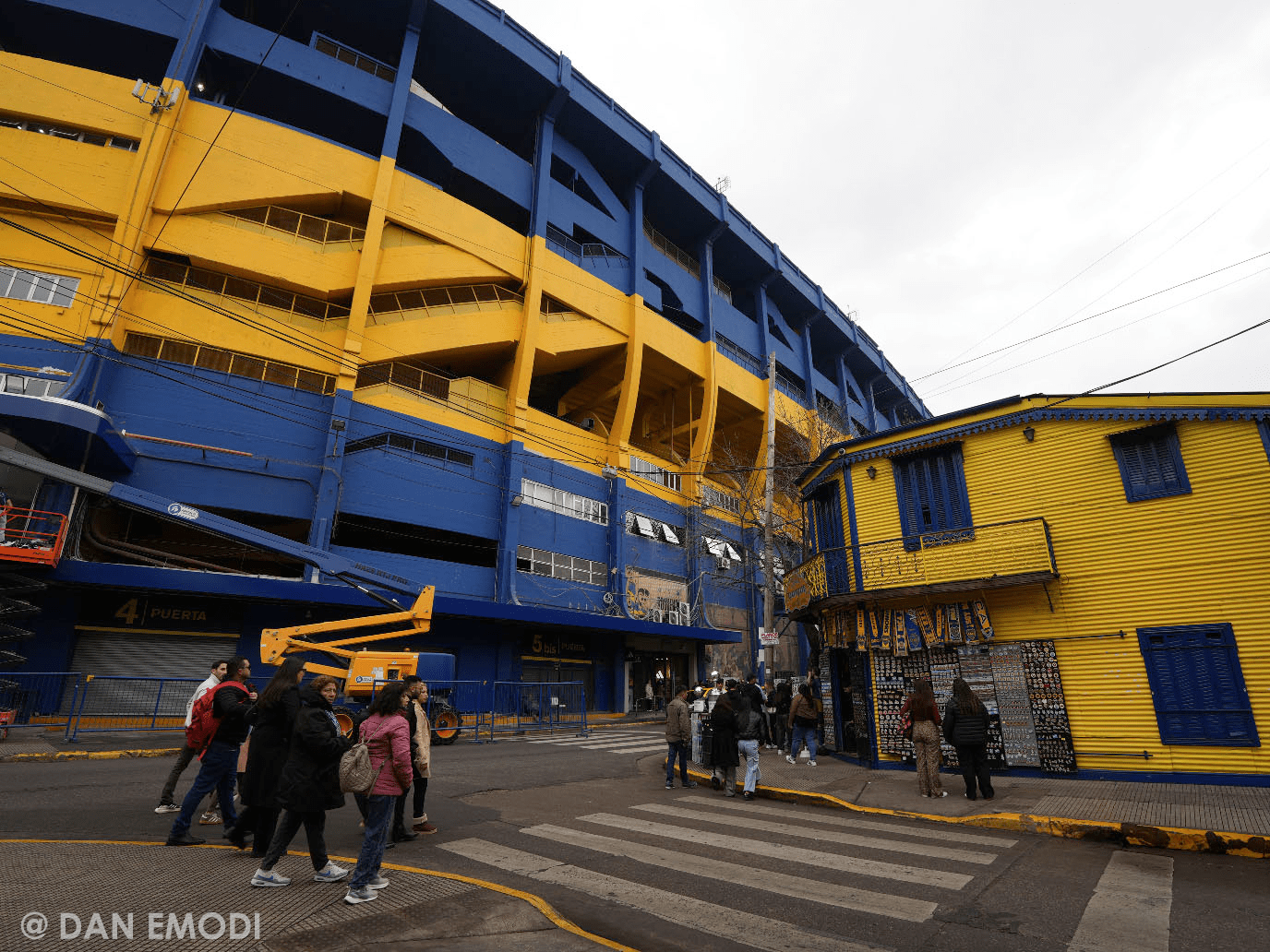
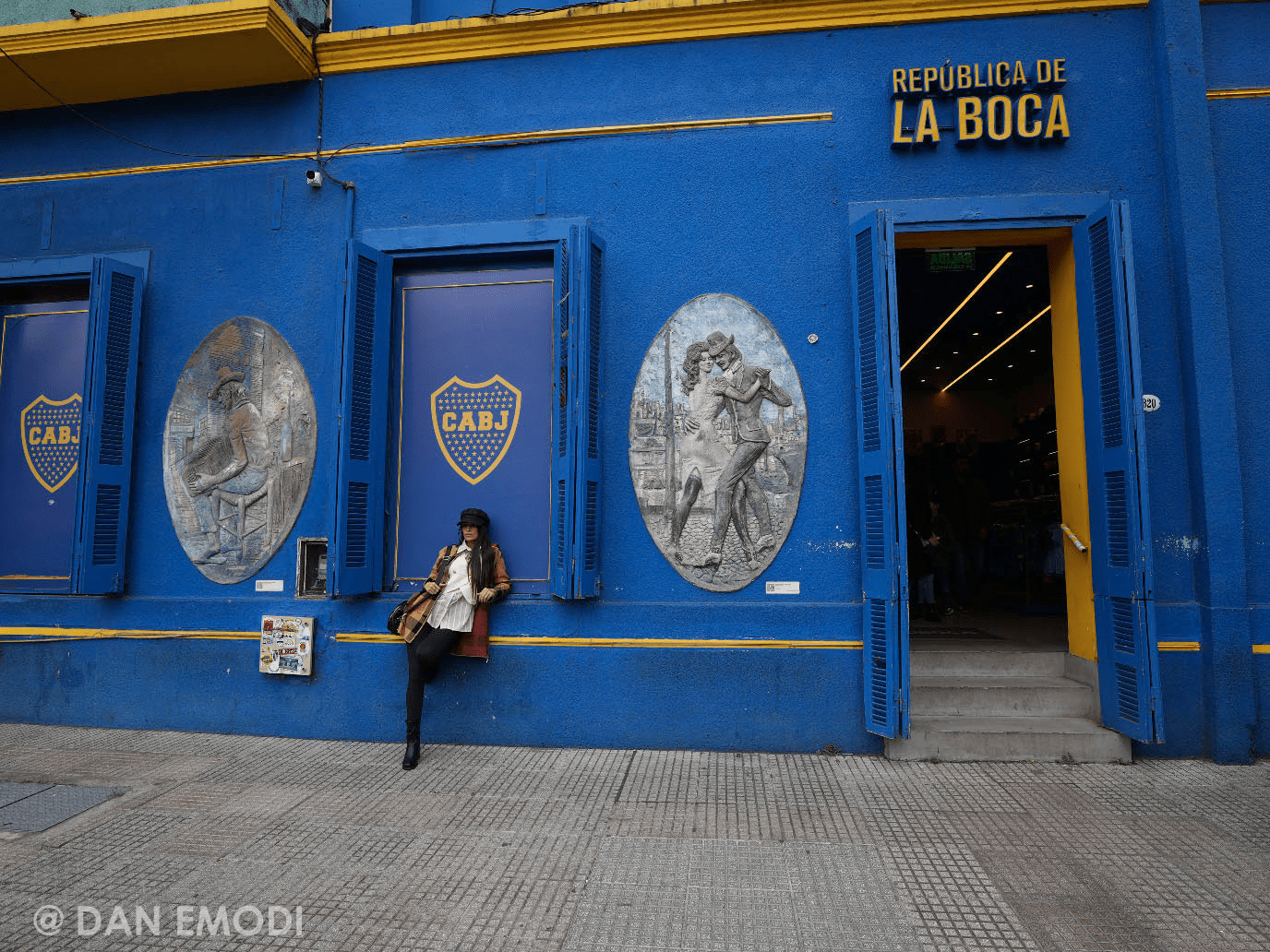
It was a grey, cool June winter morning (southern hemisphere seasons are opposite) when I, and a few of my colleagues, stepped out of the tiny Uber cab and straight into the Blue & Yellow eyesore that is Boca’s Bombonera stadium. This truly ugly concrete structure sits smack in the middle of Boca and looms well above it. The locals must have had a good sense of humor, nicknaming their Football field after a box of chocolates.
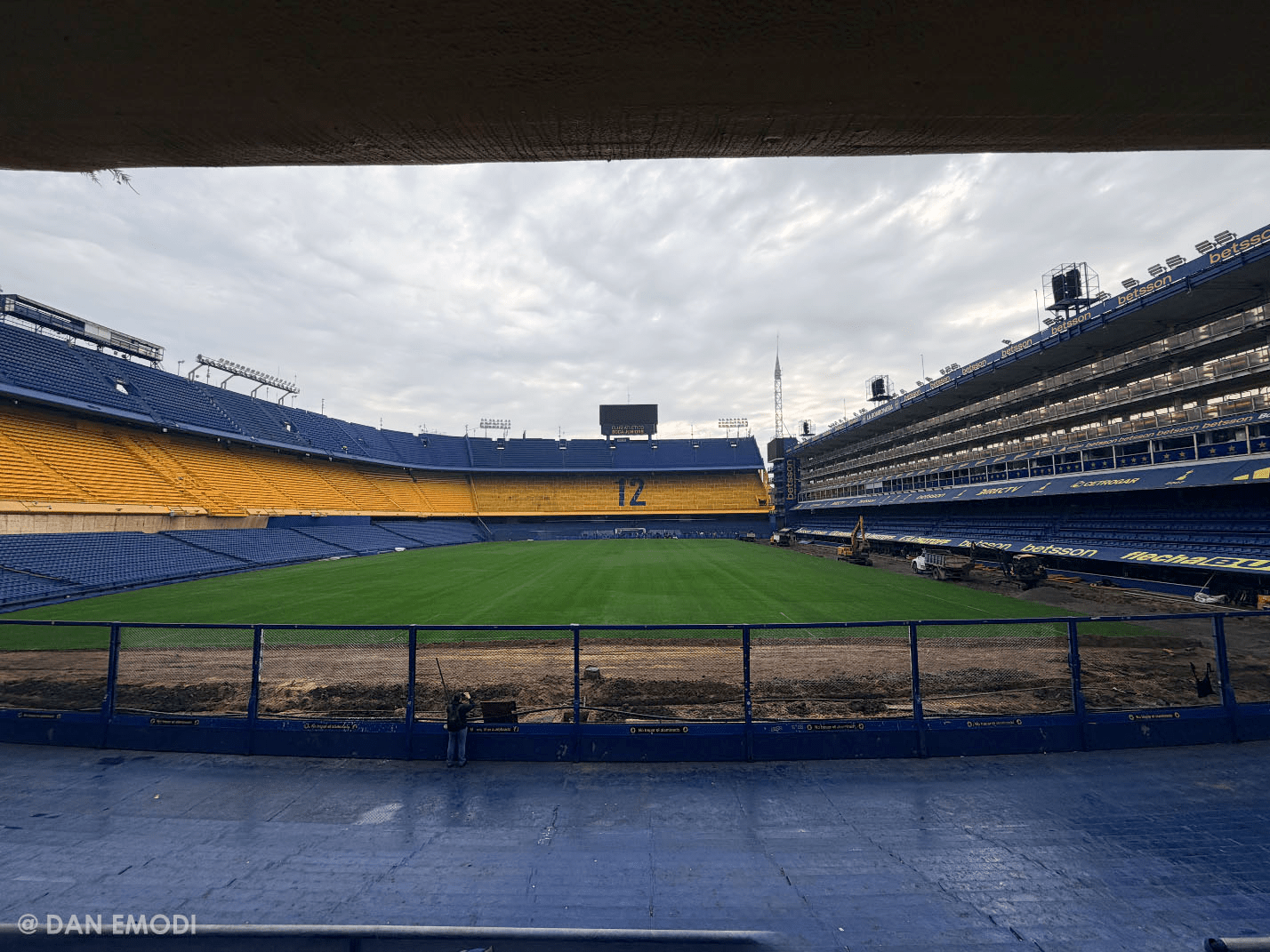
Or, perhaps it’s what happens inside the stadium that makes the place so sweet? For the sake of science, we parted ways with the equivalent of $25 each and went inside to find out for ourselves. Being one of the top clubs in a football-crazy continent, Boca Juniors’ shrine to the “beautiful game” is a must for any football fan. Yes, if you happen to erroneously call football “soccer”, you don’t count! And like every true religious monument (no River Plate pun intended), it has a very clear and prominent disciple – Maradonna.
Short, crazy, Argentinian maestro (No Messi, not you)
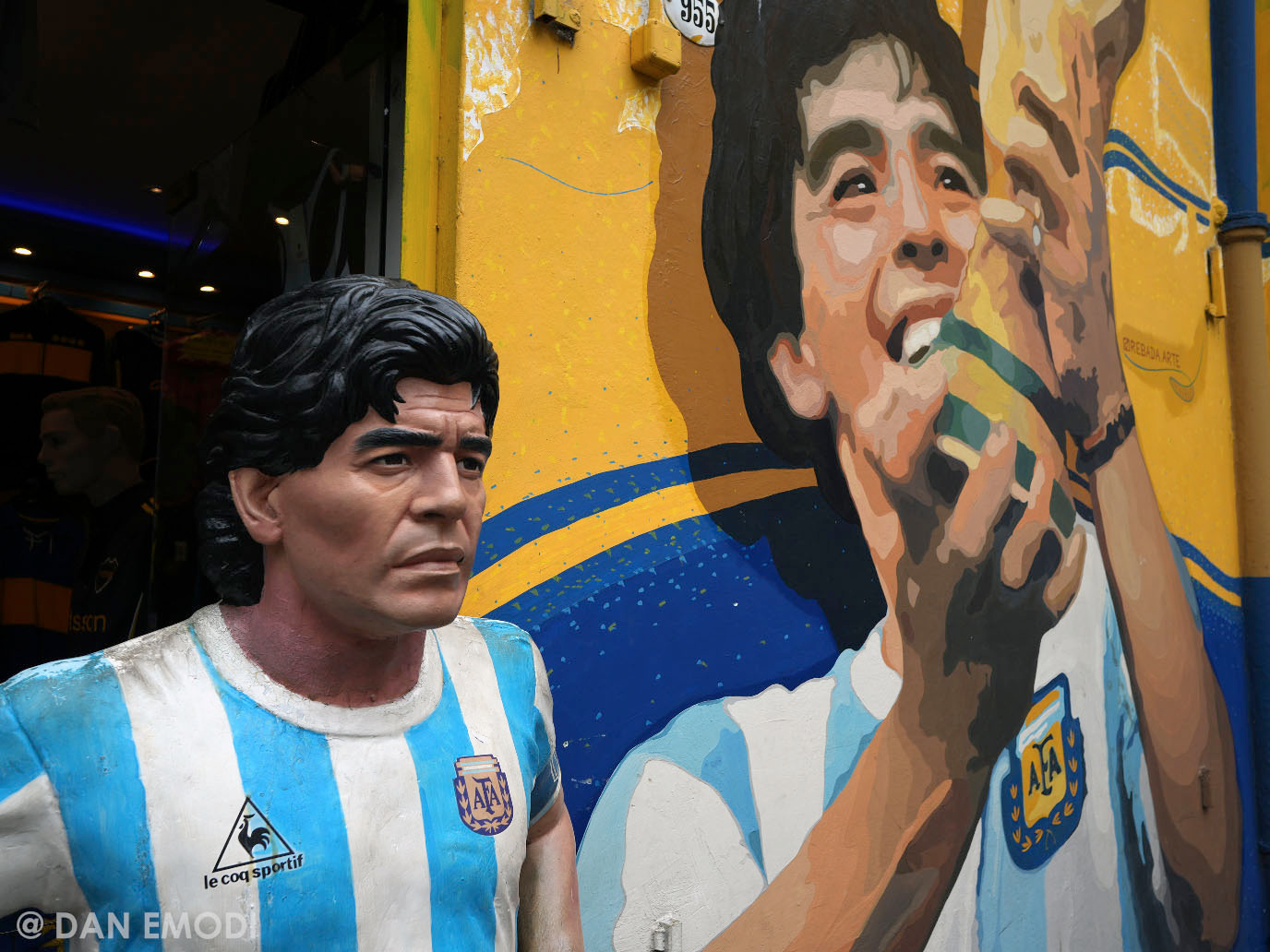
Roudy, gifted, crass, hero, SoB, Maradonna was all of them, and then some. One of the world’s best players ever, the short, fiery, extroverted, and controversial footballer is likely the best-known sports legend in recent memory (sorry, Pelé). Like Keith Richards of The Rolling Stones, Diego Maradona has also tried in his career almost every drug known to science. Unlike Richards, he died at age 60. Despite his untimely death in 2020, his imagery is very much alive on the narrow streets and shanty houses of the ‘hood. Like Jesus of Nazareth, many in Boca anticipate his resurrection. Until then, some have resorted to Messi worshiping to fill up the void. More on that later.
Maradonna was, and still is, the best character representation of Boca. The two goals he scored against England in the 1986 World Cup are still being discussed and analyzed to this day. One was the worst football travesty ever (“Hand of God”, anyone?), the second, an amazing masterpiece of speed and control never to be matched, let alone surpassed. Born into poverty and raised in the slums, Maradonna was also a loud proponent of the populist left, embracing the likes of Castro and Maduro. This sits well with the vibe of La Boca, which has largely positioned itself with the disfrenchised poor. Love him or loathe him. Maradonna is Boca, and he has made it world famous.
So famous, in fact, that very few people know that he only played for Boca Juniors for one single season in 1981. Religion lesson #1: Don’t mix myth with facts.
Join the crowds
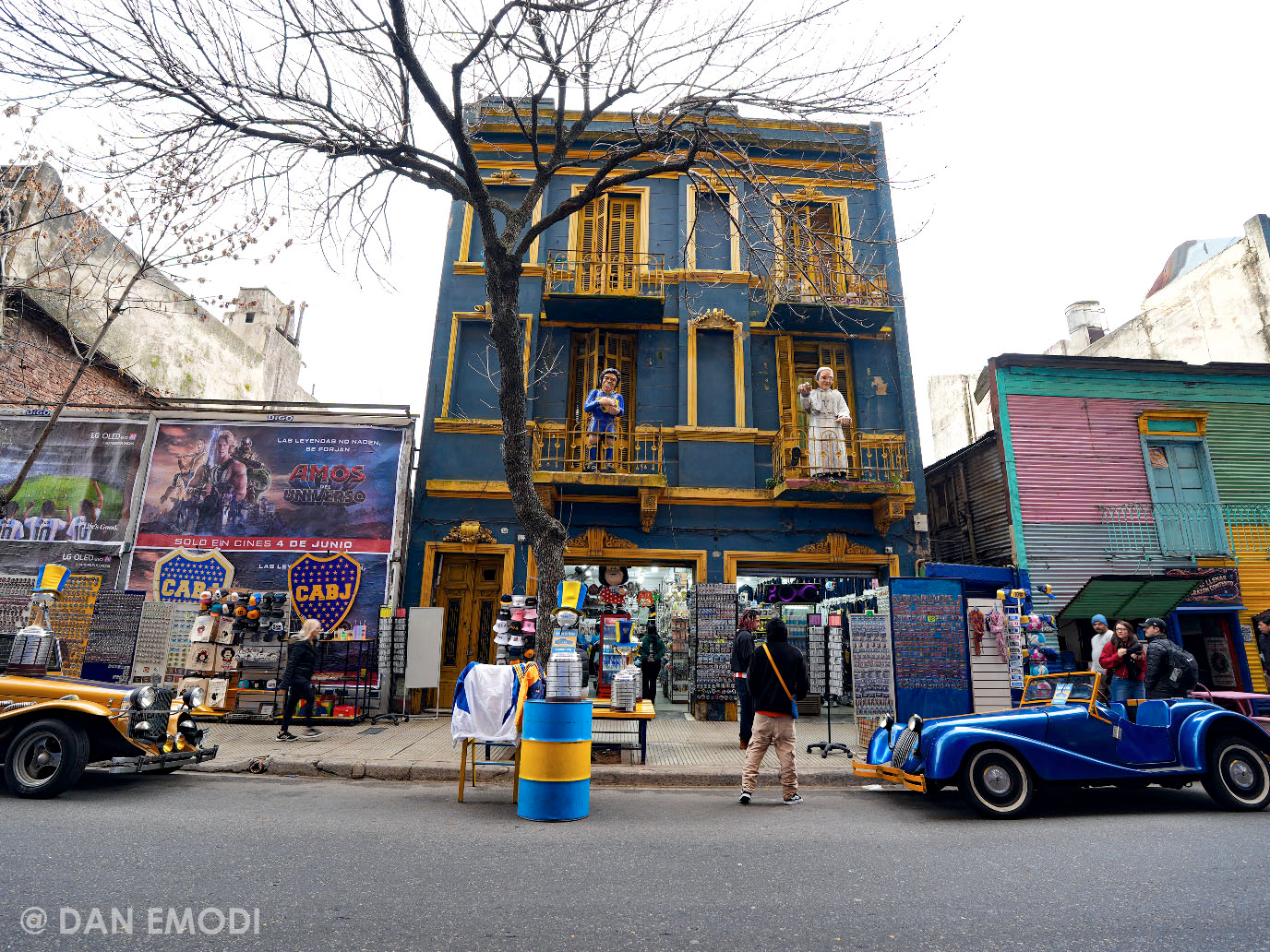
We exit the Bombonera after snapping a picture of the green and head into the bustling General Brandsen Street. The small houses, like the stadium opposite them, are all painted with the team’s blue and Yellow colors. Tourist shops offer football knick-knacks and Boca memorabilia to the throngs of passersby. One also offers River Plate shirts and scarves. Sacreliege!!
Above it, a second-floor balcony features life-size figurines of Maradonna and the Argentine Pope Francis waving at the folks below. I can only assume this was done as an insurance against the place being torched by Boca Junior fans. Despite June being way off-season, the streets leading from Boca Juniors’ center to the heart of the neighborhood are full. And while they aren’t overpacked, they’re certainly not empty either. I would hate to imagine how these same streets look in the height of the tourist season.
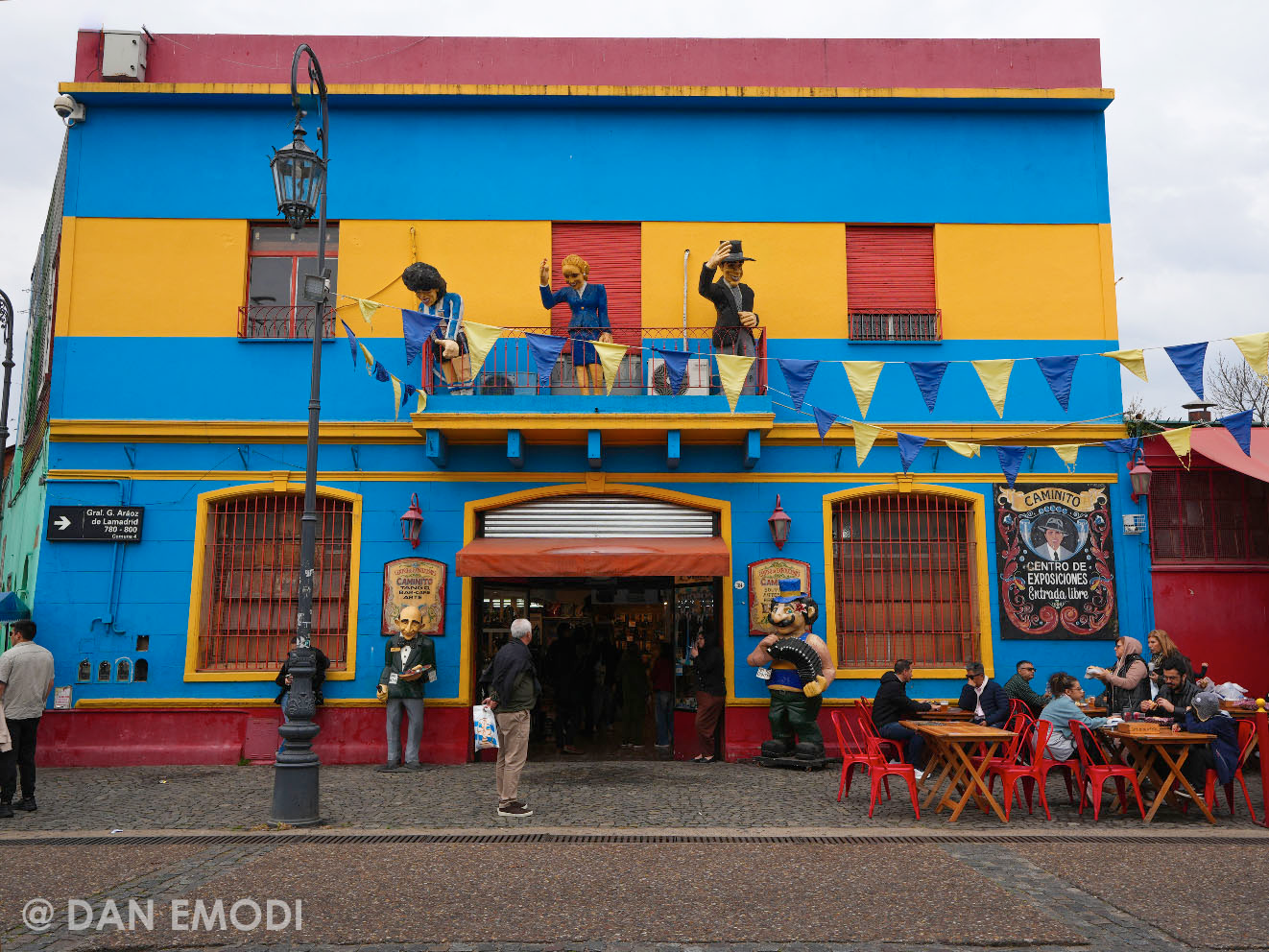
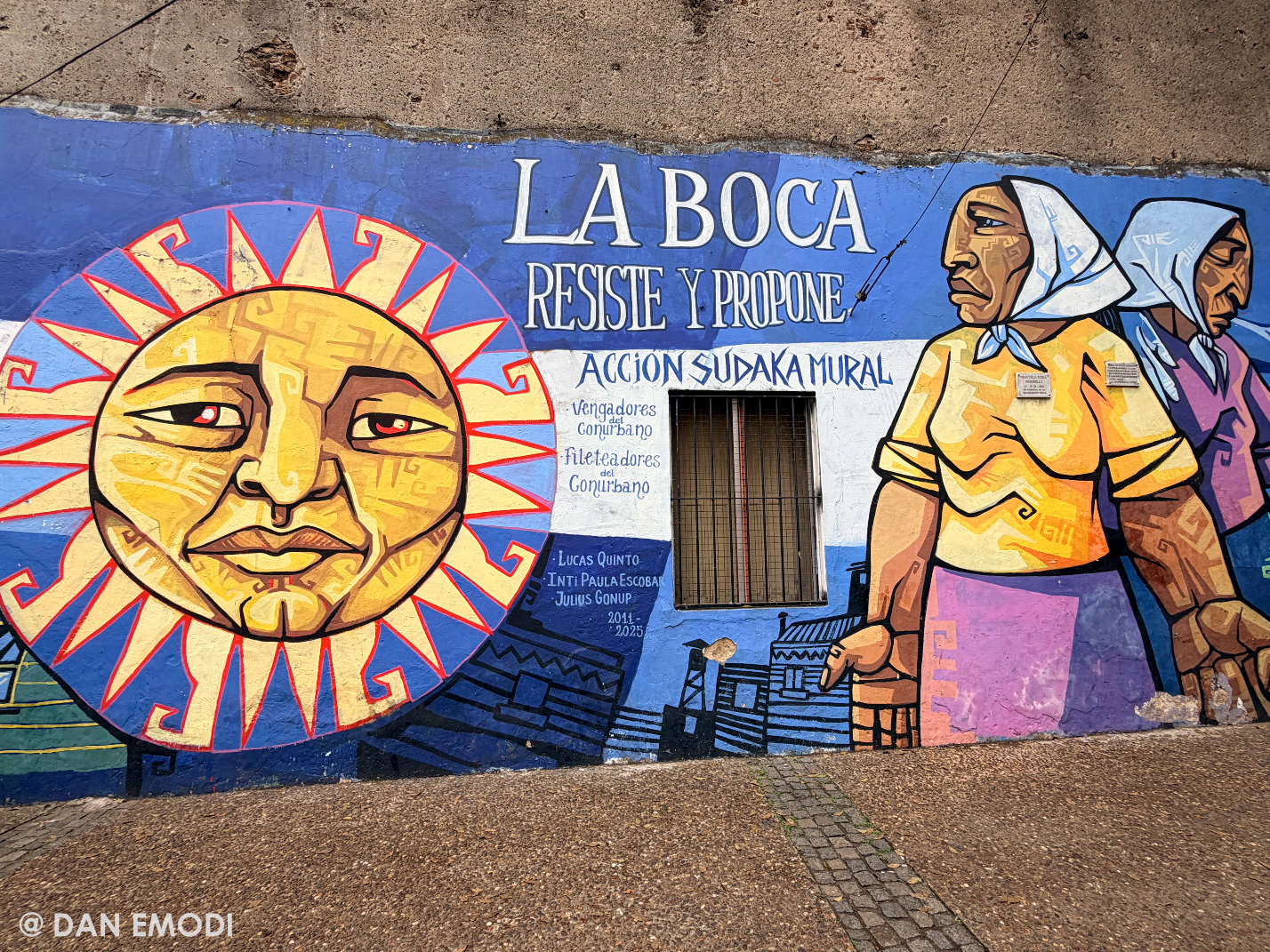
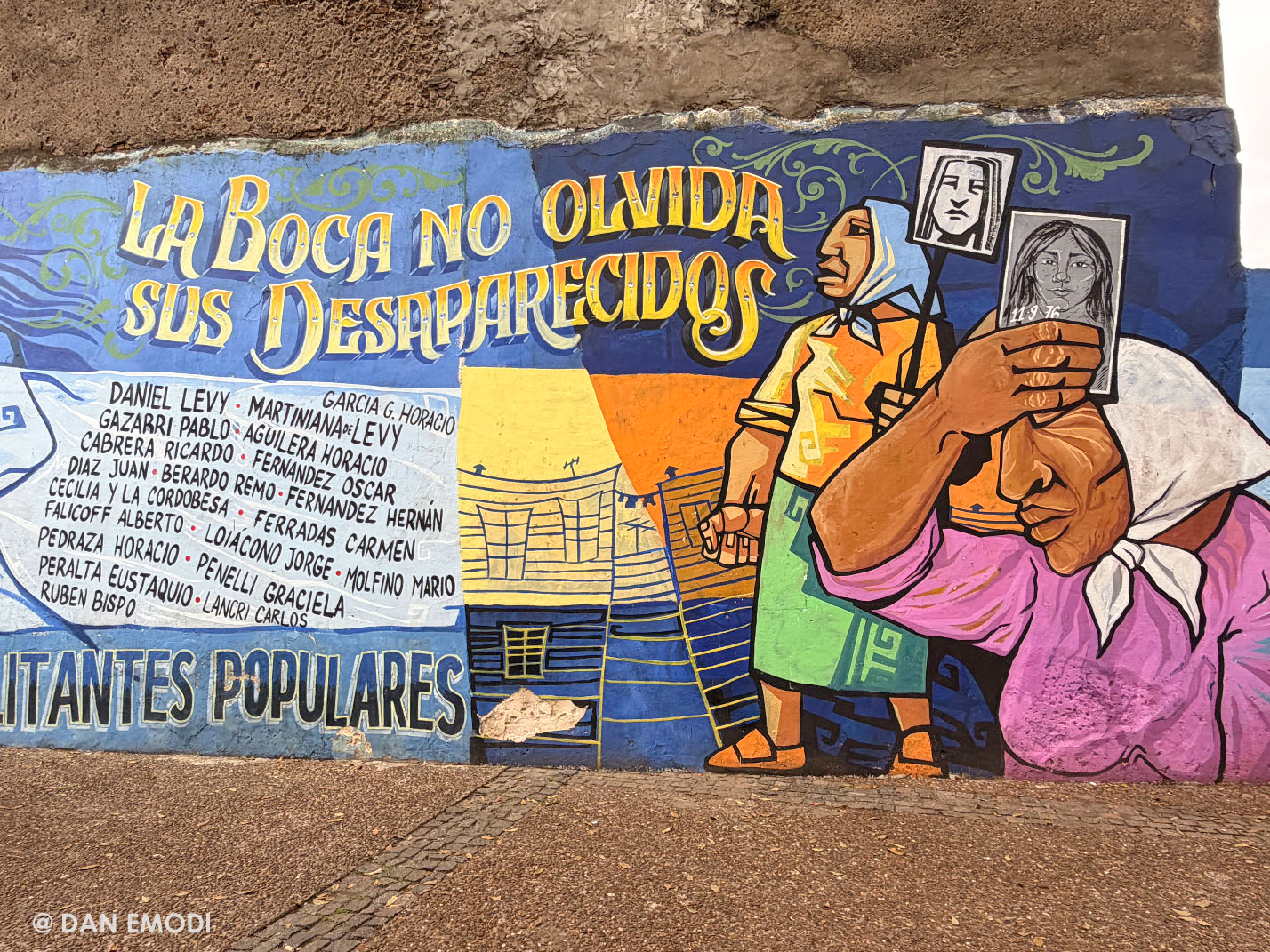
We continue on Brandsen and turn left into General Jose Garibaldi, a narrow pedestrian alley that also accommodates decommissioned railway tracks. The railway ends rather abruptly on the corner of Plazoleta Bomberos Voluntarios de la Boca, a long name for a rather small square engulfed by colorful houses, eateries, and coffee shops. The alley features some very impressive wall murals, amongst them one exceptionally impressive one dedicated to the struggle of the “Mothers of the Plaza de Mayo”. These were the mothers of abducted, and often disappeared (i.e., murdered), left-wing activists, hunted by the ruling Junta during their reign of terror in the late 70s and early 80s. The paintings are a reminder of a dark period in the country’s history, and a wound that never really healed. We stop to observe the frescos up close. You should, too.
The king of Choriso (but not of Empanadas)
Finally, we arrive at the small square dedicated to the very first volunteer firefighter brigade in Argentina, founded in 1884. The open space features the Firefighters Monument alongside a Meso-American-styled wall mural depicting the history of the local firefighting group, as well as some unrelated Boca Junior motifs (like, what did you expect?). Climbing the ramp on the north side of the Plazoleta provides an overview of the colorful houses and throngs of passerby on the opposite General Araoz de Lamadrid street. On the corner of Lamadrid and Garibaldi, El Rei Del Chori “The King of Sausage” is busy roasting, well, sausages (duh!) on a small outside grill. We stop for excellent Chorizo and forgettable Empanadas. Our bad, we should have taken the sign more seriously. Speaking of signs, one cannot help but chuckle at the audacity of naming every single street in left-leaning La Boca after dead generals.
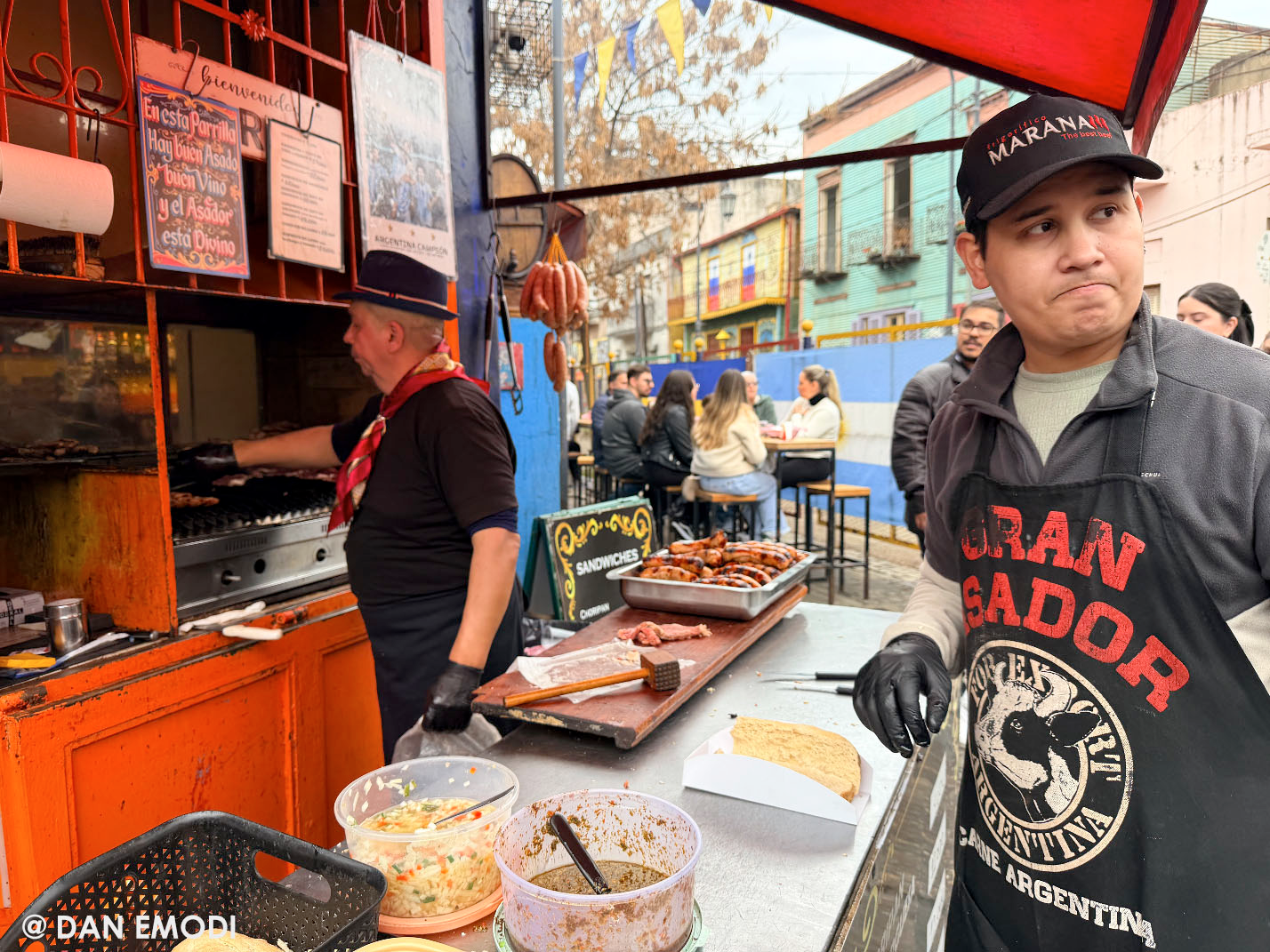
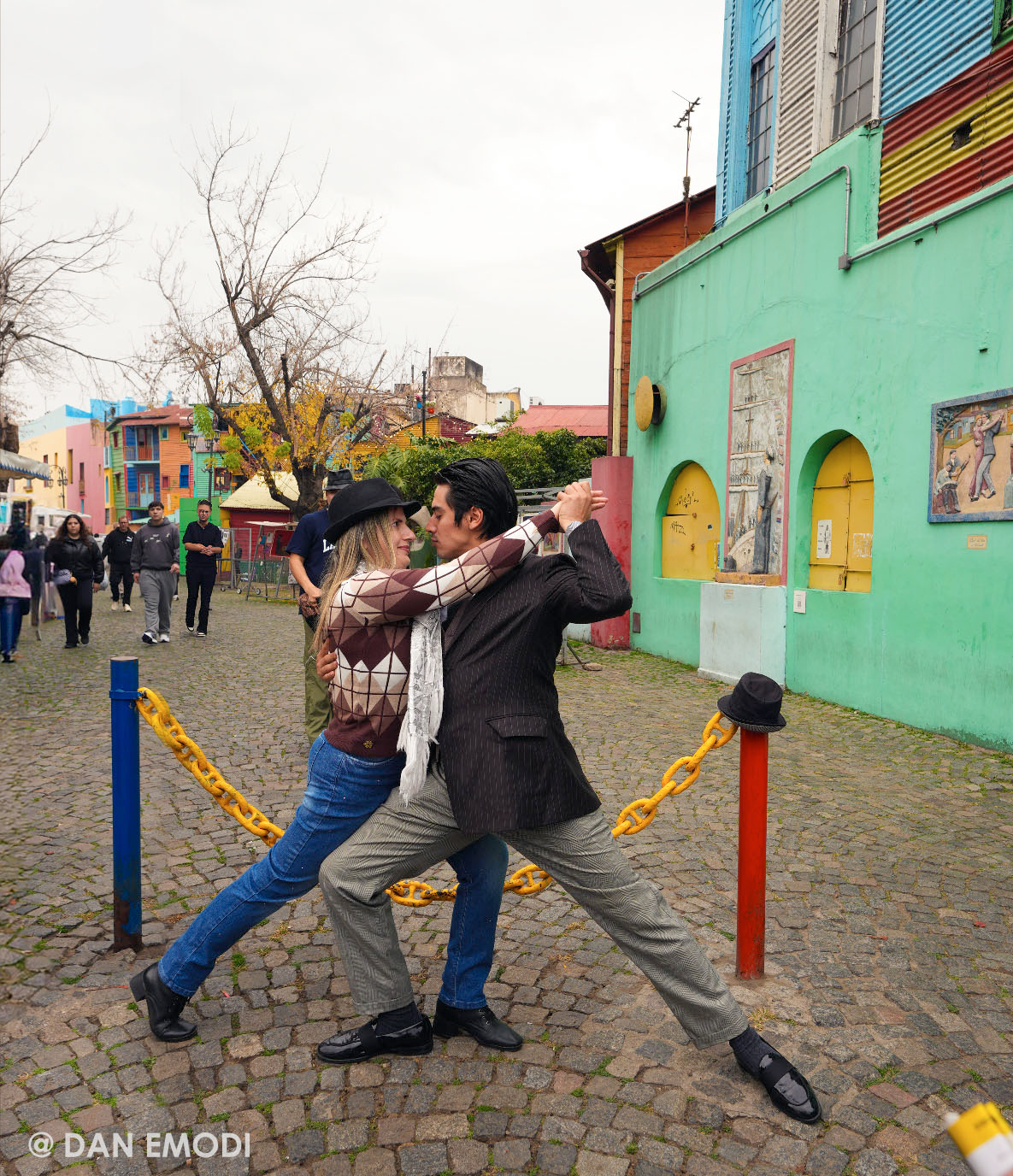
Anyway, time to change direction and head to the other corner of the square. There, a Tango dancer-for-hire is holding an occasional tourist while posing for the cameras. This sight is the entrance to the 2nd most famous part of La Boca – El Camenito. The little street, as the name suggests, is a short 150m alley, connecting the Plazoleta to Magallanes street – see?! Not just dead Generals, now dead Admirals too.
Sic transit gloria mundi
Google says, “El Camenito is world-famous as a vibrant, open-air street museum that embodies the cultural soul of Buenos Aires. It is celebrated globally for its unique architecture, deep ties to the birth of tango, and compelling immigrant history”. OK. Now I get the Tango-for-hire stint. In reality, however, Camenito is just an alley. You can find colorful houses everywhere. Just stroll around the ‘hood and take pictures at leisure. You can forgo cramming into this tiny street with multiple others eager, as you are, to check the “El Camenito” box on their Buenos Aires’ “must see” list.
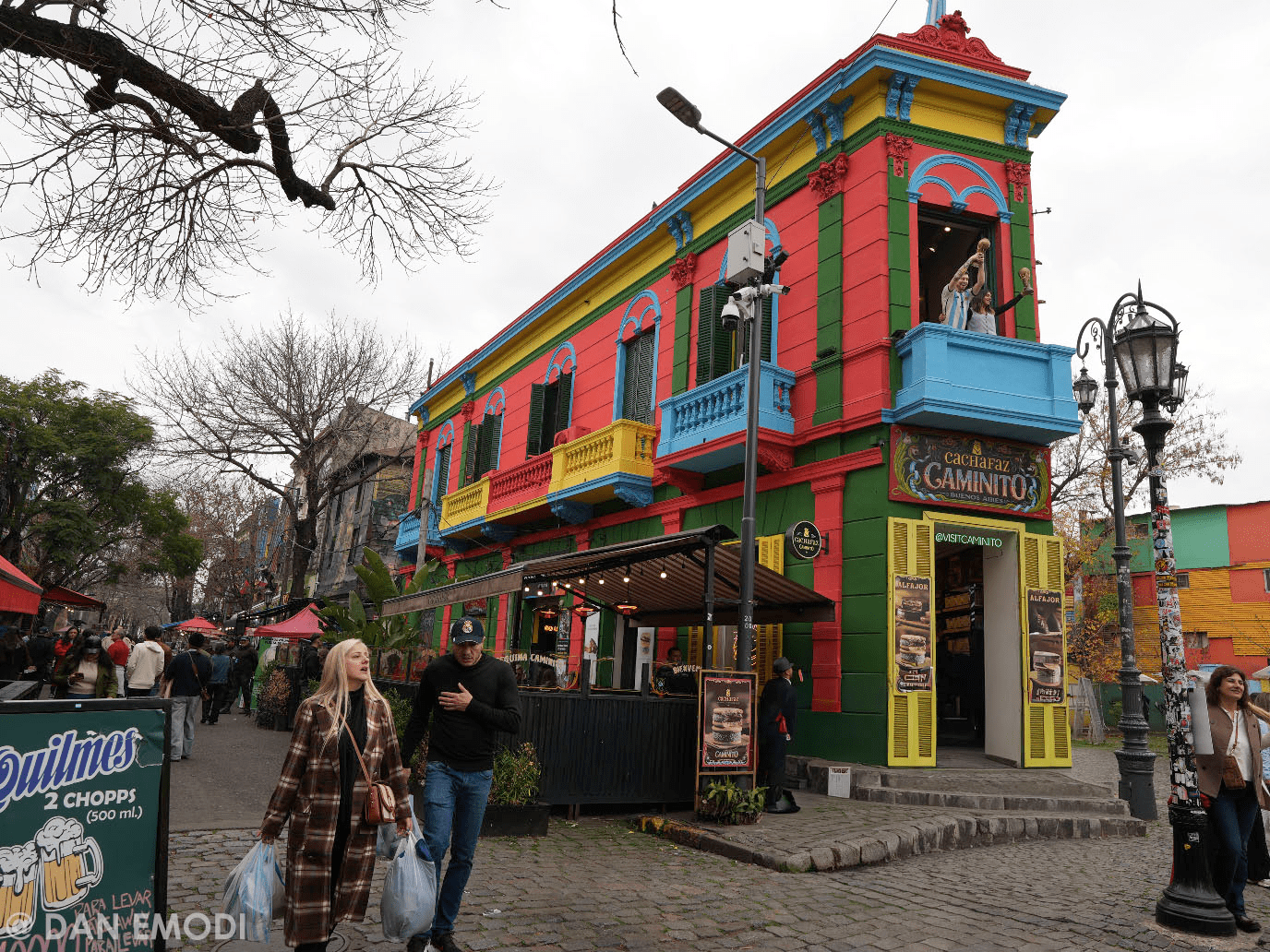
Magallanes Street is lined with the same vibrant-colored houses and hosts a number of Tango halls. Since this is lunchtime, we skip the empty, dark Tango joints. And head down the street to the point where it meets the other side of El Camenito. A long queue stands outside a bar selling ice cream. Pazzled at first, we look up and spot a life-size Messi doll holding the 2022 World Cup, peering down from a 2nd-floor balcony. A year ago, it was Pope Francis. But now it is 2026, Francis is dead (and forgotten?), and the World Cup is on!
We’re now reaching the end of our Boca tour near the mouth of the Matanza River. Just a stone’s throw away from Buenos Aires old port. Crowded, colorful, and vibrant, La Boca lives up to most of its reputation. Full disclosure: we didn’t get robbed or pickpocketed, so I guess we’ll need to come back at night. Is it worth your time? Yes! Just don’t tell a thing to your friends if they happen, like mine, to be River Plate fans.