

RIDING FROM STURGIS TO RUSHMORE
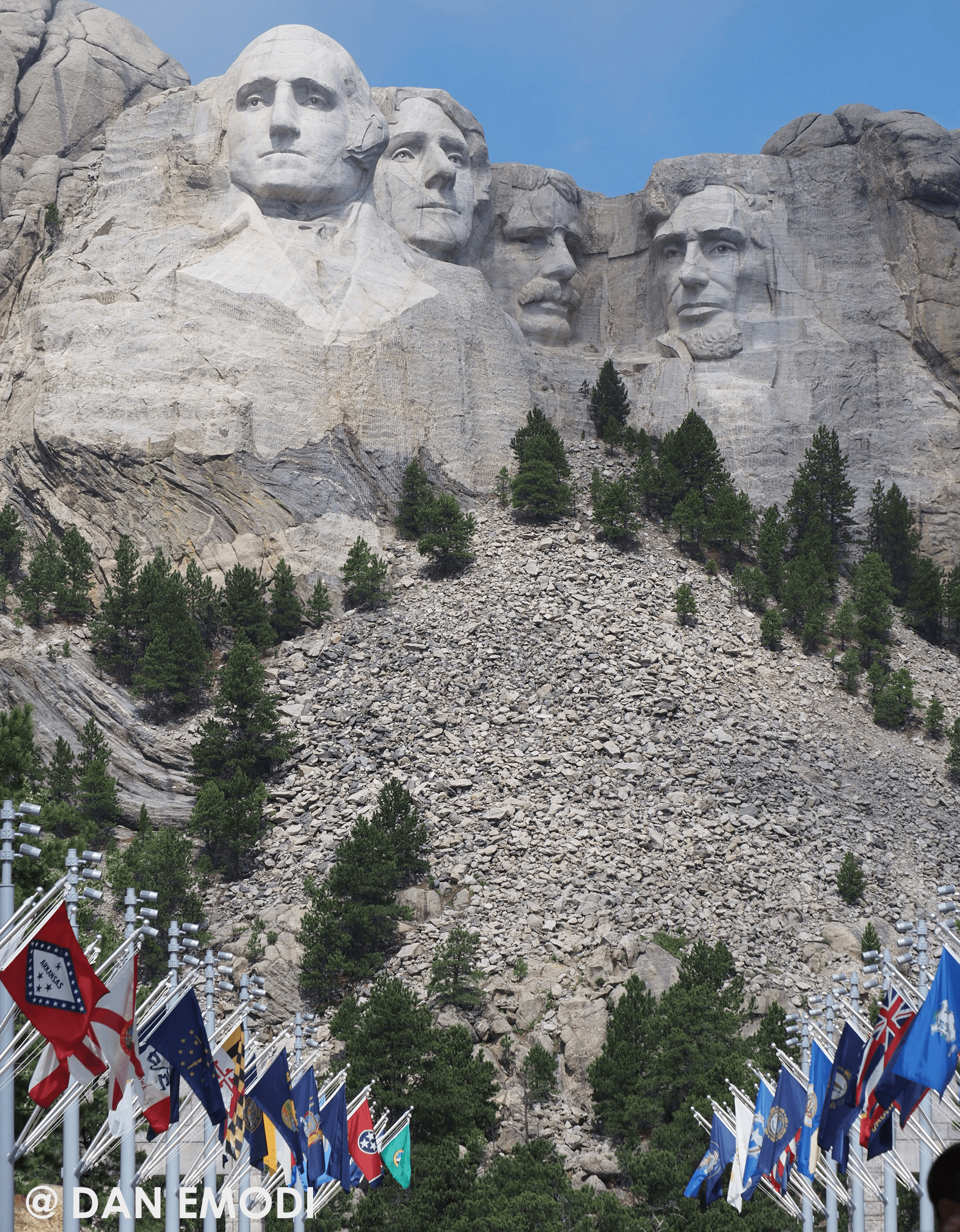
Now, peaking in between the low-lying clouds, I recognize four towering faces, chiseled into the light grey cliff. gazing into the distant horizon, they resemble those rock-carved figures from “The Lord of the Rings”. Only this is no fantasy film, and these are not kings. Well, not officially, anyway.
Dakota House
The last American King was George III, and that was 250 years ago. Since then, the United States has had Washington, Lincoln, Roosevelt – a total of 45 Presidents, and yet, the specter of monarchy has never waned in the land of the free. And if you think I have gone bonkers, or perhaps just had one too many, then you’ve never been to Mount Rushmore. The place is a shrine.
Not that visiting Rushmore is easy. For a place so universally famous, it’s ridiculously hard to reach. The towering mountainside lies in the heart of South Dakota’s Black Hills region. More plainly speaking, it’s in the middle of f***ing nowhere. Just a notch less remote than Hubbard Glacier, Alaska. Lucky for it (and for me), Mt. Rushmore IS next to Sturgis. And if you’ve never heard of Sturgis, you’ve never been a motorcyclist. And if you’ve never been a motorcyclist, well, shame on you! Now, get yourself a proper Harley, and read on.

No kings! Sort of…
It’s ironic that a nation born out of a bloody rebellion against a monarchy will hold its own civilian presidents in the same regard. Nevertheless, you can’t argue with facts, and the massive carvings of Rushmore are as factual as the massive reclining Buddha in Wat Pho. With this in mind, let’s try to understand why a nation would choose to idolize its elected leaders to the point of divinity. Some theorists point to the unique position of the US president office, which has both real political power as well as the symbolic, unifying role of a monarch. Count me a skeptic on the “unifying” stuff.

Others claim that with no royal family to speak of (Kennedys and Kardashians don’t count), this “elective kingship” satisfies deep-seated psychological and cultural desires for a national figurehead. Be it as it may, the fascination and reverence for the presidency are very real. Some would even point to a “cult of personality”, and don’t get started about the current occupant of the Oval Office.
Deadbeat in Deadwood

It is an early August morning in Sturgis. Of the hundreds of thousands of bikers attending the Sturgis Rally, most are still fast asleep. Probably hungover from a wild night of drinking and partying. Sturis, if you’ve never attended, is much about both. I wake up, all groggy-eyed, and step outside into the cool, crisp morning. A few short minutes later, and I’m already riding the 100 or so Kilometers that separate the Harley Mecca from the President’s Temple. It’s all very religious around these parts, I note to myself. I’m also quite apprehensive of the road, which is, for all practical purposes, empty as an apocalyptic movie scene. The usual Zombies, apparently, don’t get out before 11am.
Love weird shrines, temples, and other bizarre places of worship? Try these posts and tell me what you thought.
*  You only die twice
*  He's not heavy, he's my saint
*  Eyes open shut
*  Shangri-La is officially found
*  Stunned and amazed on the banks of the River Ganges
My first stop is a small town called Deadwood. Honestly, this is how the 19th-century founders chose to call it. Founded illegally somewhere in the 1870s, Deadwood quickly became the poster child of the chaotic wild west town. Known for its brothels, gambling dives, liquor saloons, high noon-esque main street shooting duels, and general lawlessness, Deadwood attracted all the motley crew of the wrong kind. Murders were common, and justice for murders was not always fair and impartial. Deadwood attained further notoriety when famous gunman Wild Bill Hickok (a.k.a.Wild Bill) was killed in 1876. Both he and Calamity Jane are buried in the town cemetery.
Nothing of that grit and authenticity remains today. All that remains today is a Disney-clean Main Street full of tacky tourist souvenirs and even tackier casinos. The only robbers in today’s Deadwood are the “one-arm bandits” in the gambling houses and the coffee shops selling outrageously bad and expensive cappuccinos. I didn’t check for prostitutes. Here’s a traveling tip for you: old Deadwood is dead. You can avoid its modern makeover without feeling like you’ve missed out on anything.
Black Hills? Really?!
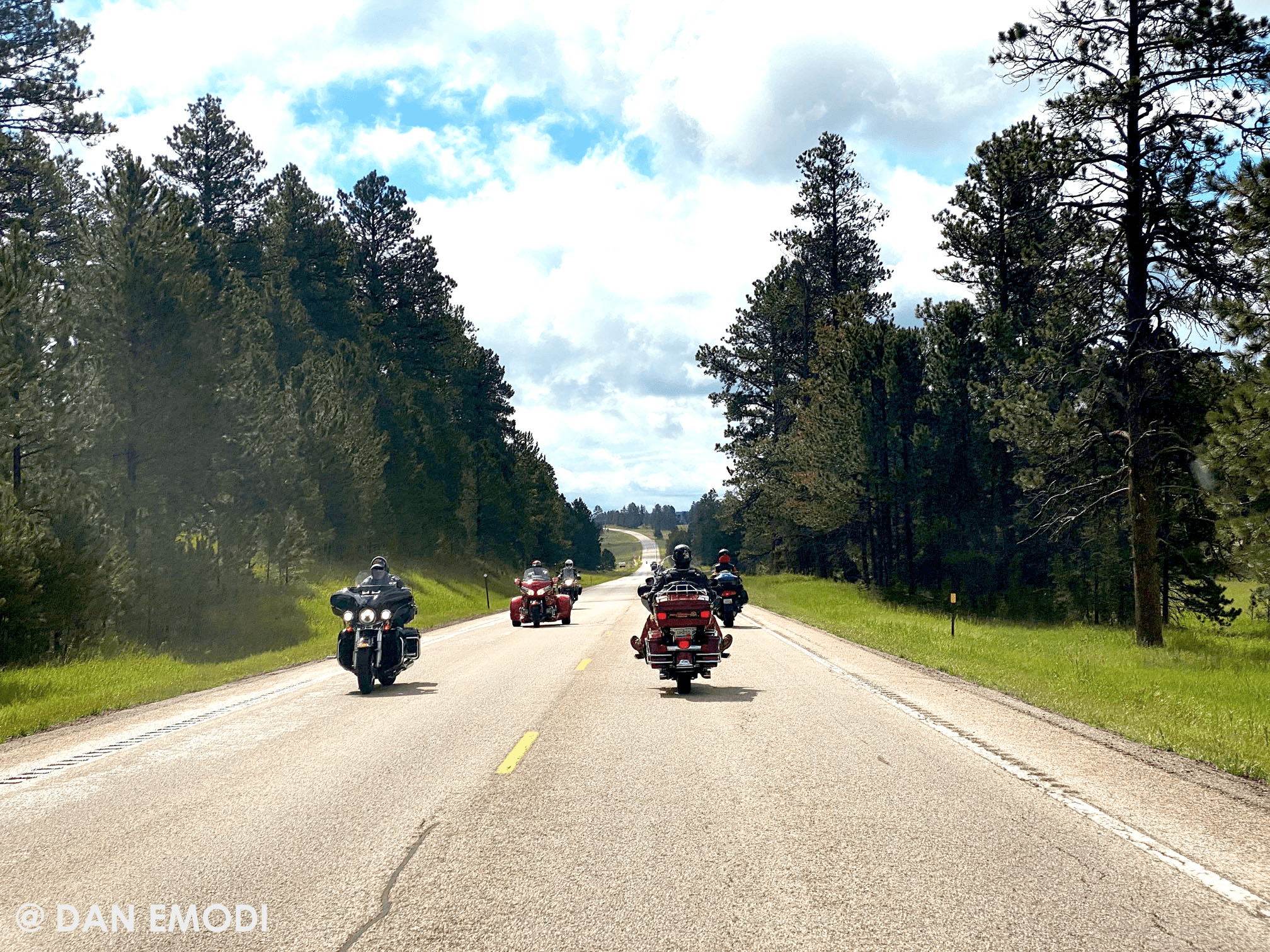
The road, now just slightly less empty, continues from Deadwood south as it gradually climbs up the Black Hills range. It is beautiful to ride, lined with tall evergreens and dotted with the occasional group of riders who, like me, set up early to beat the crowds. “Everything is relative”, I think to myself while closing the gap between Rushmore and me. To start with, the hills around me are not really Black, and nor are they hills at all. With a 2,100m peak, the “Black Hills” are in fact a mountain range, and a misty one at that. As I near the target, that mist is getting thicker. I wonder if the whole idea of venturing out to Rushmore was the right thing to do, when the grand monument appears in front of, in between the clouds, at its full glory.
I had to stop to take a photo. It is the one you see on top of this post.
Finally, I have arrived at the Mount Rushmore National Monument.

The place’s empty. Bring on the sculptors!
The idea for the Rushmore monument was originally conceived in the 1920s by South Dakota historian Doane Robinson. He wanted to create a massive shrine (yes, it is a shrine, more on that later) in the Black Hills region to boost the state’s tourism economy and to celebrate the first 150 years of American independence.
It took sculptor Gutzon Borglum 14 years to carve Mount Rushmore. Between 1927 and 1941, a crew of about 400 workers used dynamite, jackhammers, and chisels to blast and shape the 20-meter-high faces of U.S. Presidents George Washington, Thomas Jefferson, Theodore Roosevelt, and Abraham Lincoln. To complete the mammoth task, workers were suspended from steel cables at the 150-meter cliff edge as they drilled closely spaced holes in the rock. Excess stone was broken by hand before the faces were smoothed to a finish with bumper tools.

Gutzon died in March ’41, leaving the completion to his son, who didn’t get too far when the onset of World War II, and the US Congress stopped it forever. The impressive monument was never really completed. The original plan was to include the presidents’ waistcoats. I guess the US Congress thought faces were good enough. Looking up at the sheer cliff face, I must say I quite agree.
American-styled temple
The shrine to the US presidents lies on a rock platform opposite Mount Rushmore. It begins, like any proper monument to America should, with a massive parking area. From there, a wide, straight promenade takes the visitor into the site’s main gate. Entering it, like entering a place of worship, is through a structure of double arches and a massive gift shop. Paying a nominal entrance fee, the Avenue of Flags continues towards the cliff, flanked on both sides with 50 flags and plaques representing each state of the union, complete with their date of inauguration.

The Avenue ends at the Grand View Terrace just underneath the rock. The four presidents’ faces tower above the visitor in regal majesty. The view is immediately recognizable from the numerous photos you’ve seen before, but still manages to impress. Perhaps impress is not the right word in this context, as the impact is truly awe-inspiring. Washington, Jefferson, Lincoln, and Roosevelt don’t look like presidents; they look like gods.
So what’s the story with Teddy?
I recognize three of the faces instantly. They all appear on US bank notes (Jefferson does too, on the rather rare $2 note), except the fourth one – Roosevelt. No, I’m not talking about the famous Franklin Delano Roosevelt, the longest serving president who led the nation through the hard days of the Depression and the 2nd World War. This one is of Teddy Roosevelt, the slightly less famous distant cousin of FDR. I’m reminding myself that the 2nd Roosevelt president was still alive when the statues were completed. Unlike Trump, I believe FDR never expressed a wish to be immortalized in stone while still in office.
The explanation for this rather odd choice is spelled on one of the plaques. The idea in choosing the presidents was to symbolize the nation’s four stages of development. By that I mean the four stages as seen 100 years ago. These are: Birth, Growth, Preservation, and Development. Washington represents birth. Now that’s an easy one. Jefferson represented growth with the purchase of Louisiana from Napoleon and the Louis and Clark mission to open the American frontier – both happening under his stewardship. Lincoln stands for preserving the Union during its most difficult time – the American Civil War. And Teddy is for development, being the guy in charge of constructing the Panama Canal, his trust-busting work to regulate big business, and his nature conservation efforts. Okay, now I understand.
It’s Sturgis time, again.
The Rushmore site is impressive, but at the same time, it is also one-dimensional. A few minutes of admiration, a few photos, and a quick visit to the Lincoln Borglum Visitor Center, and you’re done. There’s also a night show of special illumination, but I didn’t stick around that long. The folks down at Sturgis have already woken up. It was time for me to go back.
